

The Mad Trapper Of Rat River
THE CARTER REPORT
Transcript
(For Images go to next page)
Constable William Carter
I was sent in from Edmonton on Special Assignment to the case. There was no copy of my Personal Report to the Officer Commanding "G" Division, Edmonton, of the Johnson case, as it was secret.
On arriving at Aklavik, via plane (Pilot Wop May) on Feb. 5, 1932, about 3. p.m., I immediately got together a northern kit for travelling and we left for the Rat River the afternoon of the 7th arriving over the area an hour or so later. We spotted the main camp then went farther up the river where we spotted four men high on the banks of the Rat River.
We circled and wagged the wings, and I managed to get a snap of the four. They were pointing up the Rat so we took off and came low enough to spot a single snowshoe trail which led up the river. Wop rose to about a thousand feet and we continued on, following the trail which finally disappeared off the river. We decided to patrol a little then returned to a likeable site for landing -- a few miles from where we had seen a camp fire and close to the four men as previously mentioned.
We landed on a bare no-bush area on the banks of the Rat River, and my heart was in my mouth as we stopped a few feet from going over the cliff. A Dr. Urquhart was with us also, he having come along just in case his services were required; but on the arrival of a couple of dog teams, he was informed no one had been hurt or wounded. When we landed I made a fire from some wood which was carried in the plane, and Wop May and his mechanic drew the oil from the "Belanca", which I placed on the fire. After this was done I proceeded to take a picture of the scene. About an hour later the teams came up.
As I was to join the hunt, the oil was placed back in the motor. It started okay and Wop taxied back and came toward the place where we had previously stopped. Again my heart was in my mouth as the plane neared the edge of the drop, but Wop got it off.
One team went back to the outlying camp and I returned with Napoleon Verville to the main camp. It was a bright afternoon and I took a couple of snaps when we came to Johnson's cabin; one of the cabin as it was (later more about this episode), and one from across the Rat River looking at the far bank and the cabin -- where one episode of the "hunt" took place.
Arriving at the main camp, I presented myself to Insp. Eames, who was sitting among several men in a large tent. He looked less of an Inspector in the Mounted Police than any of the other men looked like Constables. They sure were a rough looking bunch, but it was only a few days before I became a duplicate of any of the others. I also gave Insp. Eames a sealed letter which he opened and read after I had saluted and said: 'Constable Carter reporting for duty sir.' Insp. Eames introduced me to all of the men who were eating supper and which I joined in, thinking it was pretty rough fare.
Insp. Eames and I later went outside of the tent. He asked about ammunition and Mills bombs (hand grenades) which he had requested from the O.C. in Edmonton. I informed him of the discussion the O.C. Edmonton and myself had had. Evidently the O.C. in Edmonton had decided Mills bombs were unnecessary and the replenishing of ammunition could be done at the trading posts. Also, there was a law in effect that live ammunition and explosives could not be transported by plane.
I bedded down in one of the tents for the night and the next day I was detailed to take Cst. Millen's body to the plane, which would be coming back with supplies and landing in the same spot as it landed previously. I transported Cst. Millen's body by dog team and waited for the plane, a distance of about 15 miles from the base camp.
When I returned to the camp that same afternoon, Constable May from Old Crow detachment had arrived along with his guide and interpreter and two white trappers from the same area.
I bedded down again in the radio tent (staff Serg. Hersey and Riddell) and the following day, myself in charge, Cst. May, the two white trappers, and Cst. May's interpreter, started off in the early a.m. to proceed to the area where we had flown by plane and lost Johnson's trail. Arriving in the area around 11 a.m. or so, we proceeded to split up, two to the left bank (of the Rat River) and two to the right bank with me in the centre of the river and going upstream. Every once in while we would congregate on the river and proceed on. Several trails of Johnson were checked and we found what I presumed was the place where his trail had disappeared, while I was searching from the plane. It was a bush draw with some scrub trees. Later we found a campsite where Johnson had lit a very small dry twig fire. A piece of crusty snow had been placed near the fire on a twig evidently so that it would melt into a cup. (A cup, I think tin, was found later in his packsack) All his utensils had been damaged by rifle fire, which he had left at the site where Cst. Millen was killed. The imprint of the cup was in the snow under the crust of snow.
The trail led up and across and circled back many times in the area, but we split up and checked all trails until it finally led us up onto the high hills where the snow was very hard and the trail was lost. We came back to the river and proceeded up river again. The river at this point was breaking up into small channels and islands. As there was no sign of Johnson's trail for around 5 miles, we presumed he had gone overland and travelled along on the hard snow and would not have to use his snowshoes. As the afternoon was getting on and the sun going down, we decided to return to the main camp and inform Inspector Eames of our findings. It was cold that day, Feb. 9; but sunny. We arrived in camp around 8 p.m. Everyone thought we had stayed out for the night as we had some camping gear with us but no tents. I would say the distance on the return trip was a good 30 miles, but the dogs travelled excellently knowing they were on the way back to camp.
At this point we had around 133 dogs and 30 some odd men, so it took several pounds of dog food and man food to supply the needs of all in such cold weather, at times so cold I think the temperature ranged in the -50° F area. We had no thermometer; however, at -30° F I was usually fairly warm, but at -50°F I was damned chilly, especially when I had to take my northern mitts off to use the camera. The following day (February 10) we remained in camp because of fairly bad weather; but a good number of men and dog teams returned to Aklavik. Among these men were the Anglican preacher and Lang.
The next day (February 11) I boarded the plane at the usual landing place and along with the others flew to Aklavik with Insp. Eames to discuss the further continuation of the patrols. Cst. May and three others had left for Shute Pass. Due to the shortage of ammunition and other supplies - Aklavik had been almost denuded - we journeyed to Arctic Red River and McPherson where we picked up enough ammunition and other sundries to re-outfit the men. (The calibre of ammunition required was 30-30 and 270-3000; mine was the only 303).
The 12th of February we were at LaPierre House where Insp. Eames, Frank Riddell, Gardlund, and myself proceeded to set up a headquarters from which a further search would be organized. Quarters were arranged for all of the men at the trading posts and mission; they and their dogs - including my dog team - arrived in the next couple of days.
Patrols were instituted as soon as Inspector Eames' party arrived at LaPierre House and after the arrival of the other men they became more extensive. We knew that Johnson was not far away as "Wop" had spotted the well-known snowshoe trail on the Eagle River. All other inhabitants of the area were staying around their cabins or in the settlement so there were no other snowshoe trails. Later we had talked to a couple of trappers who stated a man had called at their cabin and they had fed him a meal. They said he sure ate a lot, didn't say much but did say he was going to LaPierre House for Supplies.
There were discussions about what would be done if Johnson was met with and, although no orders were given, I'm certain the men were in accord to shoot first and ask questions later.
So it happened that those that were up in the lead commenced firing and Johnson turned to run back the way he had come. As of yet, he had not donned his snowshoes.
It was not known at the time that Johnson carried a box of .22 ammunition in his hip pocket. It was determined later that someone had hit the ammunition with a 270-300 bullet making quite a mess of the hip (Johnson had turned and was running away). Johnson donned his snow-shoes and made for the bank of the rive, presumably to get into some bush where he could better defend himself. At this point, Hersey ran over to the opposite bank where he could get a better shot. (Johnson's body was seen to jerk when he was hit on the .22 ammunition.) Johnson could not make it up the bank due to the shattered hip and returned to the centre of the river. At this point he must have been a dying man because he bled profusely.
Taking his rifle off his shoulder, he pulled it out of the scabbard; uncorked the muzzle, the cork being tied to the rifle with a string, brought the rifle to his shoulder and fired at Hersey, who was kneeling down, and the bullet struck Hersey's elbow, that was resting on his knee; passed through one lung, collapsing it entirely, nicked the heart and nicked the other lung. On his being knocked over a couple of men rushed over. I think one was Ethier (pronounced Etch-a) and some others. By this time the trailing teams were coming up to within a 150 yards from Johnson, who evidently was pinned down by the rifle fire or was unable to move and, as I said before, "a dying man." He had taken off his snowshoes and laid them on the snow; having placed his bedroll in front of him, he was lying down on the shoes prepared to fight it out.
Some of us split up to each bank and were coming up in the bush. Eames, May, Riddell, and some others were coming on his right while three of us were coming up on his left. Insp. Eames called out three times for Johnson to surrender but Johnson just waved his hand and finally Eame's section commenced firing which was taken up by the party on Johnson's left. At somewhere in this action the plane arrived and was circling overhead. "Wop" told me later that he had seen somebody lying on the bank, with another person in the middle of the river, which he suspected was Johnson, and had remarked to him mechanic, 'looks as though one of our boys has been hit so we had better go down.'
When "Wop" landed he had to course up and down a good number of times to make his own "runway" (this was his own term). I saw that Wop intended to pick up Hersey so I ran over to my sleigh and grabbed a first aid kit; then to Hersey. By this time he had been placed in an eiderdown and a fire lit close by. Hersey was bleeding profusely and I applied bandages over plugs as well as I could. We carried him to the plane, I grabbed my haversack (which contained my camera) and we took off for Aklavik.
Arriving at Aklavik we circled and, by the time we stopped, several people were close; I yelled to get the doctor and for somebody else to get a basket sled. While this was being done I got out the camera and took a snap of the plane; Joe Verville was one of a number of people in this picture.
After the arrival of the sled we bundled Hersey into it and about half a dozen of us, including Verville rushed him to the hospital about a quarter of a mile away. We had no dog team to pull the sleigh as the time it would have taken to hitch up a dog team was too valuable.We had Hersey on the hospital bed when the doctor arrived and, after we removed him from the eiderdown, our job was done and the doctor and nurses took over. The eiderdown in which Hersey lay for at least an hour, was saturated with blood and a quart or so swilling around. I later burned it.
So ended the hunt: Johnson was dead, Hersey wounded, Millen killed and King wounded. A few days later Hersey complained about a painful lump in his back. Doctor Urquhart told me that he gently rolled him over and feel the lump, took a scalpel and split the skin, whereupon out rolled Johnson's bullet. This was presented to Hersey as a memento of the Johnson hunt which had nearly ended his life. By this time all external bleeding and the internal bleeding had been stopped In Aklavik several months later, Hersey showed me the bullet, which was a soft nosed 30-30 with just a little dent on the tip. Had the bullet struck a bone head-on, it would have shattered Hersey's body.
Hersey remembers little of the trip in as he was in shock and very weak from the loss of blood; according to Dr. Urquhart he survived the ordeal only because of his top physical condition.
Johnson had seven shots or wounds on his body, not counting the hip wound. Some of these were in his right arm and possibly occurred when he was trying to get up the bank, and the posse was firing from the right. He had fired a few shots from his position but not many more before he fell silent. I presume he was unconscious from loss of blood and then dying while he still had his arm upflung to wave to Inspector Eames, who had called on him to surrender. At least that is the conclusion I came to especially when Wop May states his, Johnson's arm, was lying along his rifle. When a man is dying in -40°F temperatures his face and body assume an other than pleasant facial expression and position. The bullet in his spine may have finished Johnson off, but as I said before, he was a dying man.
Johnson was supposed to have been flown to Aklavik by Wop May and a post-mortem held shortly after by a Dr. Urquart, but this was not so. Johnson was brought in by Charlie Stewart and the post-mortem held later, a disparity of 10 days or so after the killing.
Charlie Stewart was in Aklavik when I was there, and had brought in Johnson's body. He gave me his delightful version of the rough trip he subjected the "body" to while lashed to the cariole.
Johnson's body was stored in a blubber shed at Aklavik and thawed out twice to get fingerprints. He was later buried out in the bush back of Aklavik with a plain cross marking his grave.
------------------------------------------------
Four incidents which occurred prior to my assignment to the Johnson case were later described to me by witnesses and participants whose versions varied from the Official Report. These are as follows:
1. The interrogation of Johnson by Millen at McPherson.
2. The shooting of King.
3. The incident of Johnson’s cabin where it was supposed to be dynamited.
4. The shooting of Millen.
------------------------------------------------
No. 1 - The interrogation of Johnson by Millen at McPherson
From witnesses accounts of Cst. Millen's interviewing Johnson, they stated that Cst. Millen was lax in soliciting information from Johnson of his intentions, his probable location of camp, of trapping in the country and other useful information necessary for the police to have on a stranger to the Territories. They also stated that, as Millen was an R.C.M.P., and in uniform, and identified himself to Johnson, he did not assert his authority as a policeman to obtain more specific information. The witnesses also added that as Johnson paid in cash for all goods purchased, the fact influenced Cst. Millen's questioning of Johnson.
No. 2 - The shooting of King - from Csts. King and McDowell
King and Spl. Cst. Bernard advanced to the cabin with their dog teams. Cst. McDowell and Spl. Cst. from Aklavik (Lazarus Sittichfulis) remained hidden behind the river bank; covering the cabin was Cst. McDowell, with a rifle. King knocked at the door of the cabin several times but there was no answer. Johnson was inside, as he looked through the window opening. King explained his visit but Johnson ducked back and did not say a word. King was just going to knock again when a bullet came through the door, and King fell to the ground. Spl. Cst. Bernard turned his dog team around and fled, leaving Cst. King on the ground. McDowell handed his rifle to the Aklavik Detachment Spl. Cst. and told him to cover him while he went in to recover Cst. King. McDowell placed King on the sleigh and hauled him out to the river where he bandaged King as well as he could; and the whole bunch took off for Aklavik where they arrived 20 hours later and had covered 80 miles or thereabouts. It must have been a painful trip for King, for the trail was extremely rough. They only stopped to eat and change teams on the sleigh carrying King. Inspector Eames instructed me to discharge Spl. Cst. Bernard when I arrived at Arctic Red River Detachment and hire another interpreter, but after talking to him and interviewing his wife (when Bernard wasn't around) and other residents of Arctic Red, I decided to keep him on strength. I advised Spl. Cst. Bernard of my instructions and that I was keeping him on. Spl. Cst. Bernard was still at Arctic Red when I left for a year, for service on the police boat St. Roch, and was still at Arctic Red River when I returned a year later, for another year; then I left for Baillie Island Detachment.
No. 3 - Dynamiting Johnson's Cabin - Inspector Eames' own words to me
When the posse arrived on the site, the dynamiting commenced later by throwing sticks of dynamite at the cabin, which had no effect. An attempt was made to drop a stick of dynamite down the chimney pipe; this had no effect; did not explode, or maybe Johnson defused the dynamite. As reported a bundle of sticks of dynamite was thrown at the cabin, and this also had no effect. According to Insp. Eames, 'the dynamite did practically no damage to the cabin, and it wasn't until after Johnson had escaped was the cabin destroyed by manual labour, so that Johnson could not return and again use it as a so-called fort.' The cabin was a small one, about 8' x 10' with a door to the left and a small window opening a few feet from the door and covered with a gunny sack. It was composed of logs about four to five inches in diameter with a dirt roof over the logs about the same size as the walls. When a trapper builds a cabin, the inside dirt is placed along the outside walls and roof. The logs are chinked with whatever material is suitable for chinking.
Therefore Johnson was fairly well protected from the direct rifle fire having frozen earth and logs between him and the posse, and because he was a foot or so below the ordinary ground level. How he dug out this ground is a mystery to me for no shovel was in evidence. As he was pretty adept at living off the country (he made his own snowshoes) he probably axed out a tool to shovel and dig the earth.
Ernest Sutherland had offered his services as an expert on dynamite. He had stated to Insp. Eames that he knew all there was to know about dynamite, and he could blow the shack down log by log or blow it up all at once (the previous is Insp. Eames own verbal account of the man Sutherland, as is also the following, to me in Aklavik). So Insp. Eames took Sutherland along. On arrival at the site, Sutherland was afraid to throw the dynamite as he would have to expose himself to the so-called fire from the cabin, and hid behind the river bank. (Also the man had forgotten that in cold weather, dynamite loses a goodly percentage of its efficiency -- I have been an Inspector of the Explosives Act while in the R.C.M.P. -- and I would say at -50° F the dynamite is ten per cent effective). To thaw out the dynamite the men placed it next to their bodies (the first few sticks thrown being ineffective) but nature deteriorated the power of the dynamite before it could be useful and all of it was of no effect.
The dynamite which was obtained from Blake, had been stolen from the Northern Mining Exploration cache, across the river from Fort McPherson (and which later I had to blow up by rifle fire) and was found out later by my own investigation. To confirm if necessary the investigation, I have a snap of Blake and his family taken at their cabin.
The incident of Johnson shooting at a flashlight was told to me by both Karl Gardlund and Knut Lang. The door of Johnson's cabin had been jarred open but it was dark inside and nothing could be seen of Johnson when several men had rushed by, peering in at the same time. So it was finally decided to tie a flashlight on a stick. A man would then shine it in the doorway while hiding around to one side, while another rushed by the opening to see inside. The action was carried out but as one rushed by the door the flashlight was shot out; but not out of a hand. And the above action was carried out by Gardlund and Lang; Insp. Eames was not the least involved.
Later on, on a patrol, I found this same flashlight, which had been discarded, and I examined it. The bullet had entered at the outer edge of the reflector and, of course, broken the glass; bent the reflector; and holed it, and passing through the casing. It was not a big hole, and was probably a .22 shell.
So being unsuccessful in another attempt the posse pulled away, leaving Cst. Millen and Special Constable Bernard to guard the cabin and see that Johnson did not escape. They set a camp some distance away and proceeded to take turns at guarding the cabin. Sometime during the night Johnson escaped and it wasn't found out until the posse returned the next day for another attempt at dislodging Johnson, so further patrols had to be set up to locate the man. (The foregoing is Insp. Eames' own words to me.)
I was instructed by Insp. Eames to patrol this area to look for the hand guns which Johnson was supposedly to own, check for evidence of furs taken out of the Indian's traps, and locate various other items. I presume Insp. Eames sent in his report after receiving mine on the non-successful patrol for these items but - to my surprise - when I questioned the Indians who were the complainants of the stealing of furs and springing of their traps by Johnson, I found an entirely different story. Evidently, Johnson had roughly told then to take off and had even pointed a gun at them, when they came a-visiting at Johnson's cabin. Knowing Indians very well, I can imagine they were curious about Johnson and wanted to know what he was doing in their trap area. Also it is customary to give an Indian a drink of tea and something to eat. With repeated visits, Johnson's food supply would soon be depleted, so he was stopping the visits in the bud.
Retaliating, the Indians had decided to complain about Johnson to drive him out of the country, and this was what started the long series of "hunts" which terminated in his death. I questioned the Indians about Johnson's snowshoe tracks near his cabin and their trap lines. They stated that they had seen none, but their traps were set off and presumably furs missing. Now there are trap robbers such as owls, wolves, and wolverines. If the Indians found evidence in their traps of fur, any one of these animals could be the culprit, and if the Indians had set their traps before open season (which I have in years in the north found the Indian did frequently), they may have been afraid that Johnson had found out and was going to tell the police. Therefore a fictitious complaint by a few Indians resulted in the loss of life of a man who wanted to be left alone to live a quiet secluded life; the loss of life of an R.C.M.P. Constable; the serious wounding of a Staff Sergeant of the Royal Canadian Signals; and the serious wounding of another R.C.M.P. Constable; the expenditure of thousands of dollars (plane costs - $125.00 per day, from Edmonton to the return to Edmonton), and the loss of valuable time of trappers of the Aklavik area.
No. 4 - The shooting of Millen - from Riddell and Verville
A patrol of four men were sent out to scour the countryside for Johnson. They found him camped against the river bank, fairly well up in some light bush, where fire-wood was handy. A small tarp was erected which faced towards the river, and when the four men, Millen, Verville, Riddell and Gardlund came up they heard Johnson whistling, singing and cutting wood. They debated what to do and with the decision started firing at the tarp. Altogether they fired about 200 rounds of ammunition (a good example of why there was a constant shortage of ammunition throughout the manhunt). They could hear the bullets striking Johnson's pots and pans or cooking utensils, or whatever he had. (None of these items were turned in.) After waiting two hours, and getting mighty cold, they decided to advance from different directions. Not having heard any return fire from Johnson, the four presumed they had got him. Millen and Riddell were together advancing head-on when a shot rang out, and in Riddell's own words, just missed him. He ducked down behind a bank and when he looked up he saw Millen pointing his gun off to his left at about 11 o'clock and fired a shot. Then Johnson retaliated and Millen dropped to the ground. The three men retreated and discussed the problem of retrieving Millen's body, ammunition, rifle, and snowshoes for they did not want Johnson to get the last three above-mentioned items. It was decided that Verville and Gardlund would fire at the new location of Johnson, which was about 30 feet from his camp, while Riddell recovered the body and equipment.
Riddell crawled on his belly to Millen, undid his snowboot laces: tied his feet together; placed the rifle on the body; and pulled on the snowshoes until he got him over the bank and out of sight of Johnson. Riddell felt for a pulse but there was none and, on lifting up the parka found the bullet had entered in the left shoulder, and as Johnson was higher than Millen, would have coursed downward and probably through the heart. Riddell found no bullet exit, and very little exterior blood. (Therefore there was probably massive interior damage and Instant death with a soft nosed bullet)
There were many unanswerable questions concerning Johnson’s actions and reactions from the very beginning of his contact with the R.C.M.P. in the Rat River district. Evidently the expenditure of ammunition by Johnson was minimal compared to the official report. Why didn't he shoot McDowell when Mac was rescuing King? Why did he hang around the country after each confrontation? My explanation which seems to me as logical as any, is that the man was bushed and retaliated like any hunted animal by running away and fighting only when cornered.
The official report intended as it was for official and public consumption, is lax in detailing some of the incidents, and covers up many blunders. Inspector Eames, Corporal Wilde and myself held a lengthy conference sometime after the conclusion of the case and, I presume, before the official report was forwarded "Outside", Each event was discussed and the version to be adhered to when discussing the case with the public was impressed upon me. I was also Informed that it would not be necessary to report on my part in the matter as Inspector Eames would cover the entire case. At that time I did not Inform Inspector Eames that my instructions were to report personally to the Officer Commanding in Edmonton, who was also in command of the Mackenzie area; I was to provide a verbal account of the affair, as he suspected some inefficiencies of organization and co-ordination of personnel employed in the "hunt". I was also instructed to escort the body of Constable Millen to Edmonton by plane, but this order was changed by Inspector Eames and he detailed me to take charge of Arctic Red River Detachment where Cst. Millen and Cst. King had been stationed and which was consequently understaffed. Constable King later escorted the body of Cst. Millen to Edmonton in Wop May's plane.
With plans for my immediate return to Edmonton cancelled, I was left in the north without my kit, which was packed-up in Edmonton. All I had with me was a haversack, a club bag, winter uniform, rifle, 100 rounds of ammunition, revolver and 50 rounds of ammunition. I also had a small camera, with which I had taken some very important snaps during the manhunt. Insp. Eames suggested I use Cst. Millen's blankets, sheets, etc., until mine arrived; some 18 months later my kit finally caught up to me at Herschel Island.
My report did not reach the Officer Commanding in Edmonton until the first summer mail plane since it was to include the information obtained from my subsequent investigatory patrols as aforementioned.
I presume it reached Edmonton later than Inspector Eames' official report, so that the official version was therefore the one accepted by the Force and subsequently by newspaper and magazine editors.
The Mad Trapper Profile
Some of the Behavioral Analysis was straight-forward common sense like being an outdoorsman and a builder. But I really went out on a limb with my Aviation profile.
This was very early in the Age of Flight, only 14 or 15 years after Orville and Wilbur Wright and Kittyhawk. But I had confidence even then about the Aviation indicator. Only a year earlier, a survey of serial killer professions had listed Aircraft Mechanic and Assembler as the number 1 skilled job of serial killers. So it wasn’t that big a leap. So the Profile was largely correct if we're talking about Ben Larson.
However, I did lean toward him being an Incel and someone who was an outlaw or was living an outlaw lifestyle in his mind. But I didn't commit to those theories.
Fortunately I didn't because they were both wrong. He was with Tillie Larson for 9 years before disappearing and she had five kids. He was not an outlaw in any shape or form. Constable William Carter was right—Ben Larson was "a cornered animal" and acted like one.
Almost everything else, we got right. I would also include participation in the war, which I also leaned toward but did not commit to. He was in the Balloon Companies in WWI. The only thing that we got wrong was that his father was always there and appeared to be a solid father figure and a hard-working farmer and family man. That would explain his not being in the criminal classes or an outlaw in any way.
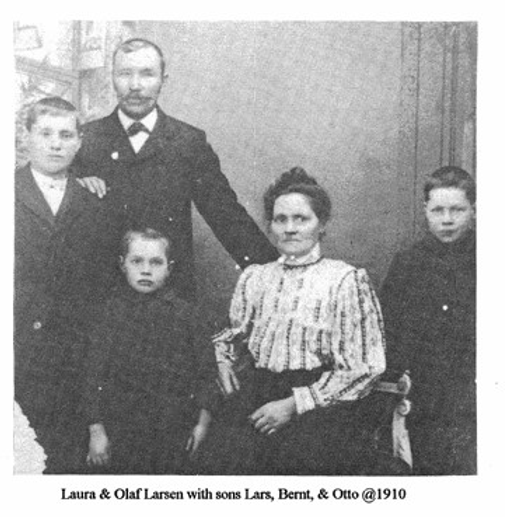
Here is a family photo with Ben, his parents and his brothers. Ben is the middle child on the right. Otto, the youngest, also went to Canada and disappeared in the 20s.

Is The Mad Trapper an Aviator
from North Dakota?
The injustice done to the so-called "Mad Trapper" is attested to by William Carter who became a Mountie after the hunt, and Bill White, Mountie and author of Mountie In Mukluks. Almost everything anyone else says about the Mad Trapper is false. He has been mythologized as the ultimate "baddy". But his relative innocence makes him good for what we want. Good. Safer.
I'd say he's relatively safe as a prototype for Anti-Social Criminal behavior. Once you know the truth about him, he doesn't engender extreme negativity that will cloud your judgment and thus impede the furtherance of knowledge — knowledge that might bring closure and justice, and prevent future tragedies.

"Legend of the Mad Trapper"
Yorkton This Week
Sept 24, 1980, p 23, Yorkton, Sask

In minus 40 degree temperatures a posse of trappers, Indians and RCMP officers engaged in the longest RCMP manhunt ever through more than 150 miles of the Arctic Circle, in pursuit of the legendary Mad Trapper.
With frozen hands and feet, skin draws tightly over bearded faces and starving features, the Mad Trapper kept doggedly laying out trail and counter-trail to confuse his pursuers.
But finally, after being tricked by Mother Nature, the Mad Trapper came face to face with his hunters only to be gunned down after a seemingly endless battle.
The Mad Trapper, alias Albert Johnson, has become a myth during the 48 years since his death. No one seems to know exactly who the man was, where he came from or what his motives were.
People have said he was actually Arthur Nelson, a trapper who vanished from sight about the time of the Trapper’s death. Others claim he was Bill Johnson, a trapper who drowned in the 1940s.
But it is known that he was responsible for the murder of Constable Edgar Millen, and the injuring of Constable Alfred King and Staff Sergeant Earle Hersey.
Helmer Domier and his wife Ida of Norquay are 99 per cent sure they know who the Mad Traper was. In fact, they think the Mad Trapper is indirectly related to them — the husband of Mrs. Domier’s cousin.
The man, Bennie Larson, was born in Norway around 1896 and immigrated to North Dakota later on. He was a soldier in the United States Army and discharged in 1919 or early 1920.
He married a Norwegian girl and moved to the Norquay area in the winter of 1920 to live with his mother-in-law.
Mr. Domier says the man did odd jobs for various farmers in the area, and worked often for his neighbor, Albert Johnson. Thus, assuming the false name later on.
Larson always carried a rifle and shot "at anything and everything along the road."
He also stole items from the farmers, and it wasn’t safe to leave a toolbox out in the open, Mr. Domier says. Larson was a hunter, a trapper and crack shot with a rifle, trailing a deer through the bush all day on snowshoes and shooting out-of-season.
Mr. Domier recalls once when Larson went north of Norquay hunting moose with a party of local men. They came across a camp by the road belonging to some Doukhobors and found bags of oats and a moose carcass hanging to dry.
Larson apparently took a bag of oats and quarter of meat. When the Doukobors returned to their camp they realized they had been robbed and took after the thief.
When they caught up to the party, Larson is reported to have picked up his rifle and planted a few well placed shots at the Doukhobor’s feet, scaring them away.
Larson used to visit Mr. Domier, and the two men would reminisce about the First World War (Mr. Domier was a Canadian soldier). Mr. Domier says he didn’t notice anything strange about Larson’s character, but he noticed that Larson liked to brag about how many German soldiers he had killed.
“He was a very bright boy,” Mr. Domier says.
In 1922 or 1923, Larson bought a team of mules and a wagon, loaded up his belongings and set off for Pine River, Manitoba where he build a log cabin and barn.
In the spring of 1927 he kissed his wife and children good-bye and left—they haven’t heard from him since. In 1943 one of Larson’s sons, Donald, worked for Mr. Domier and he said the family had no idea of their father’s whereabouts, although they had tried to locate him.
Larson’s wife, Mrs. Domier’s cousin, is living in a nursing home in Winnipeg and the four children live in different parts of Canada.
Mr Domier began wondering about the similarities between the Mad Trapper and Bennie Larson a few years ago, but didn’t make a firm decision until recently when a story written by western historian Frank W. Anderson appeared in the Edmonton Journal.
“This man is so much alike and when we saw the picture we were sure it was him.”
Both men were approximately five feet, 10 inches in height, weighed a sturdy 170 pounds, had light brown hair receding at the temples and crown, pale blue eyes, snubbed, upturned nose, moderately prominent cheek bones, and lobed ears set close to the head.
It is reported the Mad Trapper was 36 to 40 years of age, and Larson was born in 1896 which would have made him 36 years of age the time the Trapper was killed.
And, both men were of Norwegian decent and spoke with a Scandinavian accent.
The only doubt which Mr. Domier has in his mind of the Trapper’s true identity is a matter of one scar.
Larson’s brother-in-law, Herman Hansen of Norquay, says Larson was wounded in a bayonet fight during the war and carried a slight scar on his left hand near the index finger.
A physical examination of the corpse was conducted by Dr. Urquhart in 1933, and he stated the body was clean of scars, with only a small mole left of the spine.
But, Mr. Domier says the scar may have faded by the time of death, or hair acquired from living in the north for so long may have covered it. Benny Larson did have a mole on his back.
It is believed Johnson the trapper came from a large family and suffered some type of traumatic experience at one point in his life, forcing him to hate other human beings.
Mr. Domier says Larson came from a fair-sized family and knows of one incident which caused a great deal of suffering for the man. Mr. Domier doesn’t want to mention the incident in case it offends the person involved.
The Mad Trapper was very tight-lipped in his dealings with the RCMP when he arrived in the north. Little was known about him and he wouldn’t volunteer any information. Even when he was surrounded by a posse he didn’t make any noises.
Larson was also secretive about his background, talking mainly about the war, hunting and trapping.
Johnson’s presence in the northern district drew no unusual attention from the Mounted Police, until they received a complaint from some Loucoux Indians.
The Indians had set up their trap lines near Johnson’s and he slung them over the limb of a tree, almost like a warning. It was when the Trapper wounded Constable King, sent to his cabin to investigate the complaint, that the trouble began.
After that it was a six week manhunt, with the Trapper outwitting the RCMP ever time, until his death It is said Johnson climbed a tree on the river bank to survey the countryside around him.
He spotted his pursuers against the river bed. The river at that point circled back upon itself, and members of the posse believe Johnson thought the posse was actually ahead of him and heading away.
But, it was actually moving towards another bend in the river which would bring them northwards again. He returned to the river bed and began to backtrack southward to draw away from the posse.
He came running around a sharp bend in the river and found himself headed straight towards the dog sled of the posse, about 300 yards away.
Both parties exchanged gunfire, and it took 17 bullets to get the Trapper to the ground. It is believed a police bullet struck him in the hp pocked where it exploded some crtriges tearing a huge hole in his hip and forcing him to the ground.
The body of the Mad Trapper was buried in Aklavik cemetery. Years later someone dragged a large tree to the spot and erected it, marking an “A” on one limb and a “J” on the other.
The grave is untouched but the mystery has remained unsolved for 48 years. Was Albert Johnson really Bennie Larson?
“We may be wrong about this entire thing but I can’t see how two people could be so much alike and do the same things,” Mr. Domier states.

Bennie and the Profile
Ben Larson's Profile
Ben Larson
in the North Dakota Military Men, 1917-1918
Name: Ben Larson
Birth Date: 17 May 1898
Military Date: 25 Jan 1918
Military Place: Minneapolis, Minn
Army Number: 1,335,100
Enlistment Type: Enlisted
Registrant: no, under age
Parents Origin: naturalized citizen
Occupation: Farmer
Comments: enlisted at Minneapolis, Minn., on Jan. 25, 1918; sent to Jefferson Barracks, Mo.; served in Aviation Mobilization Depot, Camp Sevier, S. C., to March 21, 1918; Company A, 2nd Balloon Squadron, to March 22, 1919; 1st Balloon Company, to discharge; overseas from March 29, 1918, to June 5, 1919. Engagements: Defensive: Champagne-Marne. Offensives: Aisne-Marne; St. Mihiel; Meuse-Argonne. Defensive Sectors: Lorraine: Champagne; Ile-de-France. Discharged at Camp Dodge, Iowa, on June 19, 1919, as a Private.

An American balloon observer prepares to ascend in a captive balloon for a reconnaissance mission. Photograph from the U.S. Air Service in World War I: Volume 1.
"War plus 20 years equals Serial Killer."
Peter Vronsky in his book Sons of Cain: A History of Serial Killers from the Stone Age to the Present
So do we have a Serial Killer here or a "Cornered Animal" * ?...
As it turns out, William Carter was most likely correct in describing Ben Larson as a "cornered animal".
There's nothing to suggest he was a criminal before the Manhunt so he wasn't on the lam or anything and wasn't planning to have a showdown and a shootout with the police despite what people think about the defensive designs built in to his cabin.
He comes from a family of upstanding people. No one in his immediate family today are in any way "happy" to be associated with The Mad Trapper because of what he did after.
So what happened is just something that happened. It was circumstances brought on by police actions against a war veteran similar to what happened in Rambo: First Blood.
We end up with a Spectacular Crime.
Usually Spectacle Killings are done by the people who are or were in the highest standing in society, like BTK who worked for the government and the Unabomber who worked for a University.
Sometimes they're not as in this case where Ben Larson was a simple farmer who went to war and joined a balloon unit.
I think, in cases like this, Spectacle Killings don't happen solely by the choice of the perpetrator. Sometimes the spectacular killings or crimes are brought on by some negative, escalating dynamic as happened here with the Mad Trapper and the RCMP, or they are simply brought on by the escalation of an ordinary crimes by a criminal who is allowed to keep getting away with it like GSK.
Inevitably, his crimes will reach spectacular levels. But he doesn't have to be a government worker or a math professor, or a doctor (Cleveland Torso Killer?) trying to make a "big slash".